We Don't Just Kill the Mold.
We Stop It From Coming Back.
We work through the roof for full attic access, remove the entire contaminated reservoir, and re-insulate it ourselves. Most crews do one of those three.
Every job, we remove
of the contaminated reservoir, not just the visible mold
0
%
Trusted Across Ottawa, Outaouais and Beyond since 2004.






Ignore This Long Enough And It Stops Being Just Mold.
You're Breathing Whatever's Up There.
Air moves through that attic and back down into your home every time the furnace runs. Whatever's growing above you doesn't stay above you.
It's Not Staying In One Spot.
Mold follows moisture. It travels through insulation and into wall cavities long before it shows up anywhere you can see it.
The Longer It Sits, The More It Costs.
A small patch this year is a full remediation next year. Waiting doesn't shrink the problem. It just moves the price tag up.
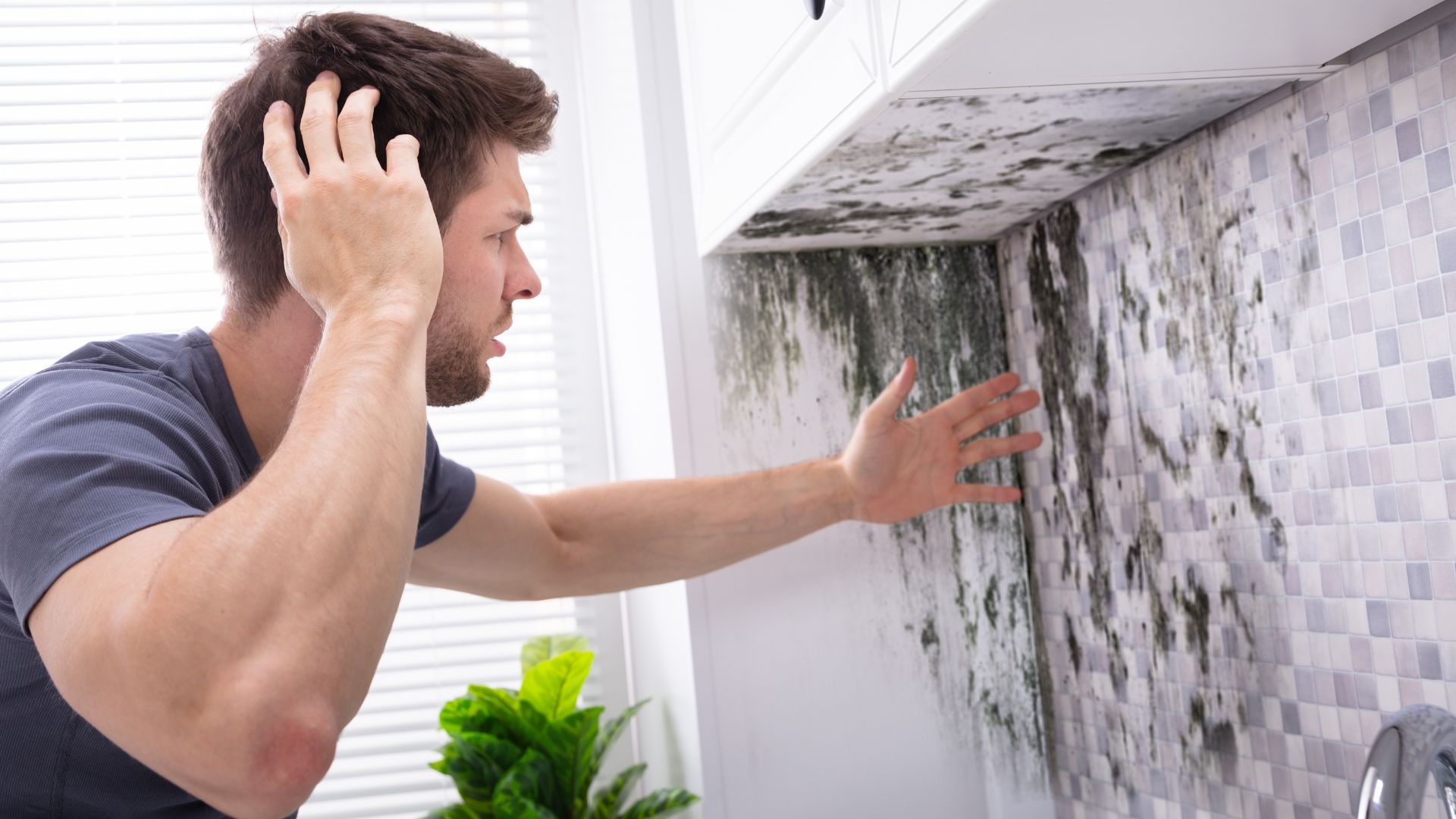
The Mold You See Isn't The Problem.
What’s feeding it is the contaminated insulation you can’t see, plus airflow that’s still pumping moisture into that attic right now.
Kill the mold without removing that material and correcting the venting, and you haven’t fixed anything. You’ve reset the clock until it comes back.
That’s the part almost every other company skips.
The 4 Things We Do That Nobody Else Does.
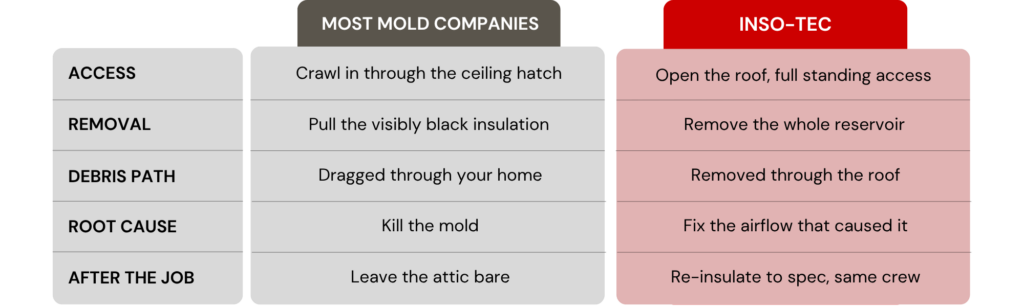
We go through the roof, not the hatch.
Hatch crews crawl an 18-inch space and drag debris through your living room. We open the roof, get full standing access to every corner, then close it back up watertight. No one else in Ottawa works this way.
We remove the whole reservoir, not just the black patches.
Mold's toxins soak deep into the insulation fibers, not just the parts that turned black. Spot-treating leaves them behind. We take out the whole reservoir.
We're an insulation company. We don't leave you with a bare attic.
Most mold crews strip your attic and walk away, you're left calling a second contractor. We've been insulating attics for 20+ years. We close the loop ourselves, to spec.
We fix the airflow that caused it.
Kill the mold without fixing the moisture source and it's back within a season. We correct the venting so it stays dry for good.
Ready To Find Out What's Actually Up There?
Free inspection. No obligation. We'll tell you exactly what's going on and what it takes to fix it right.
Our process
From "Is My Family Breathing This?"
To Air You Can Trust Again.
We come out and get a full look at what's actually going on, not a peek through a hatch. No pressure, no obligation. You'll know exactly how bad it is and exactly what it takes to fix it properly, in plain language.
Instead of crawling through an 18-inch hatch and dragging contaminated material through your hallways, we access the attic from above. Full standing room to every corner and every bay, right to the eaves, and nothing gets tracked through your living space.
Every piece of affected insulation comes out, not just the sections that turned visibly black. Mold toxins can spread deep into the fibers, so partial removal only means they return later.
Mold doesn't grow without a moisture source, and it's almost always a venting problem: blocked or undersized exhaust, a bathroom fan dumping humid air into the attic, missing baffles. We fix whatever's causing it so the conditions that grew the mold are gone too.
Once the attic is clean and the airflow is corrected, we rebuild your insulation to current R-value spec. Not a subcontractor, not a second company. The same crew that's been insulating attics across the region for over 20 years.
Every job ends with a written record: conditions we found on opening the attic, the work performed, the products used and what's in them, and a photographic record from before we started through to the finished insulation.
That includes photos after each coat of treatment, so you can see the staining lift and clear rather than taking our word for it. The encapsulant we use dries clear instead of white, which means the wood underneath stays visible for any future inspection. Nothing is painted over.
When you sell, attic mold is one of the first things an inspector flags. "It was dealt with" is a conversation. A dated report with the license number, the scope, and the photos is an answer.
Trusted by Homeowners Like You
Why Customers Choose Inso-Tec
Marc Forgues
Had insotec come in to do a small spray foam job for my basement and I was impressed with the quality and professional work they did. They covered floors from the entrance of my home all the way into the basement and any walls that could get dirty.
The crew was polite and courteous and very hard working.
Could not ask for a better experience.
Would have them come do work again and recommend them to anyone.
Mia S.
I recently had the pleasure of working with Inso-Tec for insulating my home, and I couldn’t be more impressed with their service! From start to finish the entire process was seamless, the team was highly professional, knowledgeable and punctual. They took the time to explain the various insulation options available and helped me decide on the best solution for my needs and budget.
Since the installation, I’ve noticed a significant improvement in the comfort of my home - it’s warmer in the winter and cooler in the summer. My energy bills have already started to decrease, which is a testament to the quality of their work.
I highly recommend their services!
Lyssa McDonald
I hired Inso-Tec to spray foam, insulate and add cellulose to multiple areas of my home and was more than impressed with their workmanship. They had a great team of workers, who were so well mannered & very professional. The final clean up was also very well done. I am more than satisfied with their work and would highly recommend this company.
Cedric Cahill
we have used this company for spray foam jobs and cellulous installation on multiple projects. The crews are always on time and very professional. They take all necessary steps to protect the home and always leave the place clean and looking great.
Mr. Chugg is always there to start them off and inspect the finished work. I highly recommend them. 5 on 5
Stephen Riby
I needed to have my entire floor re-done for reasons I will not elaborate on. Jeff and his team ripped out the entire floor and placed all the scrap in a bin they had supplied. They then re-built the entire floor structure from scratch and sprayed 6.5in of insulating foam between all the floor joists. My Vermont Casting wood stove has been working part-time ever since! Communication with Jeff was great (always straightforward), he will always look for a solution to any issue, and his team cleaned-up the entire work site at the end of every single day. I do not hesitate to recommend Inso-Tec for any insulation work you may require.
P.S.
Mold doesn’t take a day off while you decide. Every week it sits is another week in which insulation keeps shedding spores into the air your family breathes, and another week closer to it spreading beyond the spot you can see. The inspection is free, and there’s no pressure to book anything after. Might as well know what you’re actually dealing with.